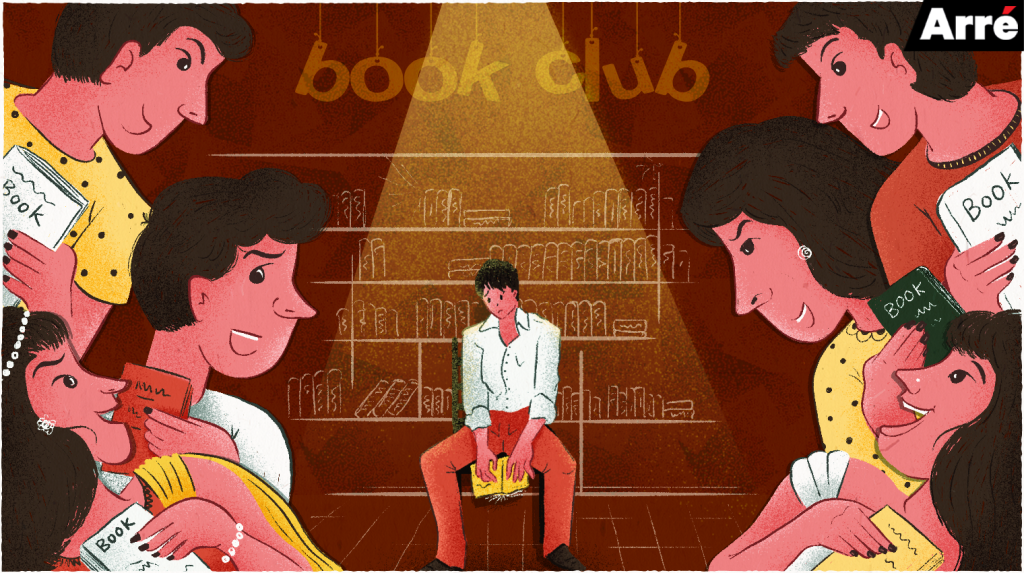

Akash was not a confident person. His command over the language was tenuous and he spoke with a nervous stutter. Add to that his choice of book, which most of the book-clubbers considered kidlit. He held up his book – a worn-out paperback, that he’d probably picked up at a second-hand book stall. The founder of the club gave him an encouraging smile, but I caught a smirk or two between the others, some giggled. Soon the heckling began – even Kunal Kamra could have picked up a few tips from the members. One of them interrupted Akash to ask rather condescendingly why at the “mature age of 20” was he reading Artemis Fowl, and the discussion swerved into the “rightness” or “wrongness” of books. When Akash found his voice again, another specimen, let’s call her Regina (because this was literally Mean Girls culture), interrupted Akash once again. Regina smiled her jalebi-sweet smile and asked him whether he was prone to “low-sugar induced shakiness”. Was that why he was stuttering so much? Akash was naturally embarrassed. “Um, what? I… no, nothing like that,” he stammered, trying hard to keep the shakiness out of his voice. Unfortunately, this wasn’t a one-time scene. It was as recurrent as the Sooryavansham reruns on Sony TV. In the few handful meetings I attended, I always caught someone secretly making fun of the not-so-popular members of the club. They didn’t need much fodder either – a grammatical error, a mispronounced word, the choice of literature. The moment somebody spoke about Chetan Bhagat or did not know what The Vegetarian was, I’d see a pair or two of rolling eyes. I realised in time that this book club was not about books at all, but about parading one’s wit, sharpening one’s sarcasm, and showing off one’s superior literary tastes. Rather, it was about showing off one’s privilege. These millennials were woke in every other way – they’d go to pride marches, they’d dump their surnames, speak about equal rights, and yet they discriminated based on “intellect”. And that, according to me, is just as bad as being a racist, bigot, or a sexist. I had always thought of reading as one of the most inclusive hobbies. After all we have heroes and heroines like the awkward Holden Caulfield, whimsical Luna Lovegood, unassuming Jane Eyre, and simple but loyal Samwise Gamgee. We root for the underdog. So how can we not be inclusive toward those less privileged? And if we do congratulate ourselves over understanding the references in Edmund Spenser’s The Faerie Queene or our tenacity in keeping up with Tolstoy’s War and Peace, we must remember the place of privilege we likely come from. Not everyone who loves books has to be fluent in English or has had a reading habit since they were children. Not everyone has had access to a library or had grandmas who read Wodehouse.These millennials were woke in every other way, yet they discriminated based on “intellect”.
Book clubs used to be places where people buried their differences and celebrated their love for everything literature. The only other book club I’d been a part of was an impromptu one at school, which was all about reading (ok, maybe a little bit of fangirling over Aragorn). Be it Tolkien or Tinkle, a crime thriller or a comic strip. Nothing was frowned upon. But the Mumbai book club was nothing like that. It was like every other collective – incomplete without a WhatsApp group, aka a group for roasting other members.When one poor fellow mistakenly pasted an incorrect link, he was met with a very rude response. When this went too far, I decided it was time to quit. In a polite yet firm message, I told them that it was time for me to part ways with the club. A book club, I told them, should encourage expression and reading, even if the book being read is a “shitty one”. I called out their duplicities and signed off. In the next hour, I received a bunch of messages from other members of the group letting me know that I had done the right thing. I’d joined the club as a way to meet like-minded people in Mumbai and I did meet a couple. For the most part though, I was introduced to a bunch of elitists, who looked down at a guy making a great effort to read his first English book in his early 20s. As CS Lewis once said, “No book is really worth reading at the age of ten which is not equally – and often far more – worth reading at the age of 50 and beyond.” If children’s books were good enough for CS Lewis, they ought to be good enough for an upstart book club.A book club, I told them, should encourage expression and reading, even if the book being read is a “shitty one”.