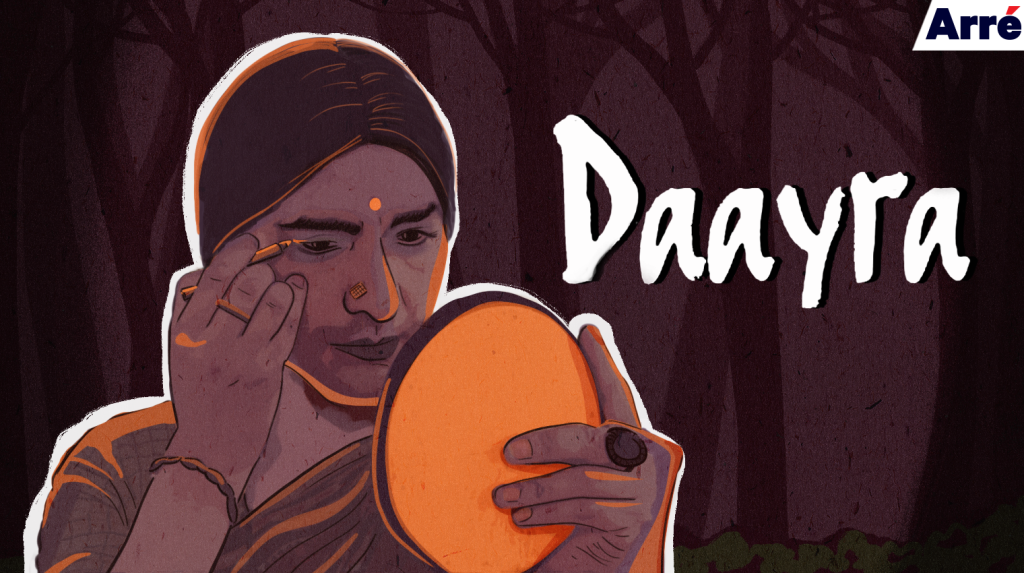


Daayraa is a sensitive exploration of sexual identity and gender stereotyping, with moving performances by both the leads of the film, Sonali Kulkarni and Nirmal Pandey.
Gateway Entertainment/ Saarth Productions
In a remarkable scene in the movie, Pandey deconstructs our society’s perceptions of masculinity and femininity. Kulkarni’s character blames Nirmal Pandey for abandoning her, leading to her gangrape. To which Pandey replies that had he stayed, he’d have been raped too. In a fit of rage, Sonali addresses him as a eunuch, neither a man nor woman. He replies, “Must one have rippling muscles to be a man? Or a moustache and a beard? Do naked breasts make a real woman? Or tearful helplessness? A man must be vigorous, a woman a shrinking blossom. I’m a miracle of nature. Within I’m a part man, part woman. It pleases me to reveal the woman within me. It matters little to me whether others accept me or not.” The Transgender Persons Bill, however, sees no “miracle of nature” among trans people. Rather, it forces them to undergo gender affirmation surgery and get their gender “certified” by the District Magistrate. The sex reassignment surgery in question, has many side effects, it is a complicated and a life altering surgery. The question is, why should as crucial a decision, not be left to the person? In yet another powerful scene, Kulkarni’s character, points out that a mere change of clothes does not change the wearer – despite the guise, we stay as God made us, some men, some women. To which, Pandey replies, “Sometimes I wonder, God who made this world, so complex, so colourful, how would he have been satisfied with merely creating man and woman? How could he have resisted from making human beings more complex?” This empathy, this humanising of a community is exactly what’s missing from the trans bill. But perhaps Daayraa’s biggest victory lies in the representation of the trans community alone. Think about Black Panther, which gave us our first black superhero almost two years ago – it has been hailed as a model success story for depicting diversity on screen. A 2011 study conducted by The Opportunity Agenda found that black males in media are usually portrayed negatively, limited to a handful of “positive” stereotypes, painted as flat characters, or missing altogether. Audiences — especially those with little exposure to those outside of their community — typically equate these limited, and harsh, media representations with the real world. It works in the same way for the trans community. Now, if only our laws could follow that mandate.Daayraa strays from convention to offer a deep insight about the struggles of being a trans person in a transphobic country.