
Y
e shabdon ka jwaala
Meri bediyan pighlaayega
These words are flames
They will melt my shackles
~ “Apna Time Aayega”, Gully Boy
Meet your new breed of journalists. Articulate, fearlessly candid, and crusading on our behalf – their film crews at the ready – in the nooks and corners of every street. They aren’t citizen reporters, they are citizen rappers.
Born in a world where they watch the social media circus around billionaire marriages on the same phone they paid that billionaire for, their sour cynicism is beginning to bubble over. Today, when the affluent minority and the aspirational lower classes uneasily jostle within India’s economic frothiness, a new, and unlikely group appears to have become the voice of the masses.
The antidote to unreliable journalists, fawning filmmakers, and jingoistic political commentators, one collective voice might just have become an unwitting substitute for the fourth estate. Sample this acerbic appraisal of the media:
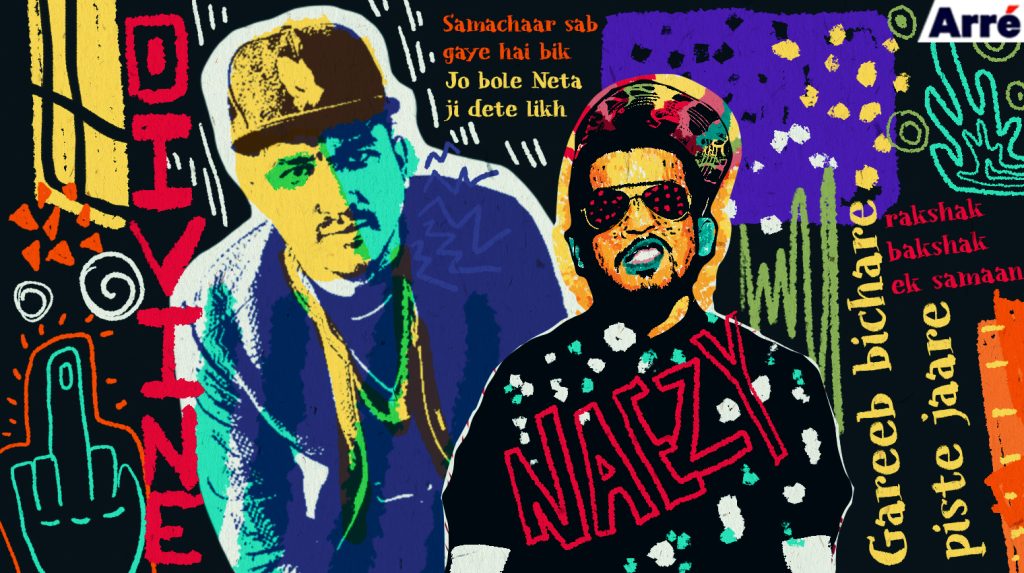
Samachaar sab gaye hai bik
Jo bole Neta ji dete likh
(In this era of paid news
Politicians dictate our media)
~ “#Black”, Spitfire
Maslon ko suljhaane waale pe hi atyachaar hai
Koshishien bekaar hai jhooti samaachar hai
(Those who’re working for change are terrorised
What’s the point? Efforts are fruitless, the news is fake)
~ “Tragedy Mein Comedy”, Naezy
At a time when the subduing of the news media and chilling deaths of RTI activists have deepened society’s trust deficit, the guardians of democracy appear to be India’s street rappers. As Zoya Akhtar’s Gully Boy focuses the spotlight on India’s indigenous rap movement, you’ll find the real message of the streets encrypted within. In the grime within the gloss, lie the signs of our times.
But let’s rewind the track a bit, and playback to a time when cinema was a living, moving, speaking reflection of the times it was set in. Raj Kapoor’s views on class politics in a socialist India hoped to remind society to rise above inequality and bear the challenges of a newly independent nation, and survive it like his tragi-comic characters did. In the ’70s, when the effervescence of an independent nation was stained by a couple of decades of cynicism, Amitabh Bachchan’s angry young man showed us how the common man might erupt against injustice. That was an outlet for middle-class frustration, a sort of celluloid activism, which disappeared in the froth spewing from a bottle of Coke in post-liberalisation India.
A new breed of street rappers who have been dishing out their lacerating critique of what needs to change. Image Credits: DIVINE/FB Mumbai’s slums have spawned Indian rap’s talismanic duo Divine and Naezy. Image Credits: Naman Saraiya/FB

They don’t deal in distraction – they draw our attention to the plight of the common man and the callous nexus between corrupt politicians, crony capitalists, and lax law enforcement. Take this for instance: Yeh sab jungle ki parchayi hai Bakriyon ke bheed mein yahaa mantriya kasaai hai Toh aaiye, hum khud hi sipaahi hai Rakshak ke naam pe yahaan mama log bhai hai (The shadow of this jungle raj darkens We’re a herd of sheep at the mercy of mercenary netas So come, let’s gather, we’re our own army To protect ourselves from our “protectors”) ~ “Yeh mera Bombay”, Divine Of course, Divine and Spitfire are a contemporary echo of India’s heretical poets, who have always used their craft to defiantly call out oppression, inequity, and orthodoxy. Kabir, Meerabai, and Basavanna used oral poetry to firmly reset our rose-tinted view of the world. That tradition was continued by poets like Avtar Singh “Paash” in Punjab or Dagdu Maruti Pawar in Maharashtra, who railed against social injustice. In today’s street rappers we glimpse a rare emergence of that same call to conscience. They are a curious mix of an indigenous influence of protest poetry and western inspiration from the likes of Tupac Shakur and Biggie Smalls who rapped their grassroots reality into lyrical truth-bombs lambasting the very society they sprang from. The Hip Hop Haiku from our hometown hecklers is unabashedly bilingual and deliberately secular, reminding us that corruption that breeds inequality still needs to be kept in check. Sample these lyrics from the Sacred Games soundtrack that crackled with impertinence: Rajneeti mein yahaan Sabse zyada paisa kyun hain? Public ko nahin dikhta Waise wala paisa kyun hai? (Why is Indian politics, flush with money? Why do we remain blind to it?) ~ “Kaam Pachchis” (Sacred Games), Divine With no political allegiance, these rappers aren’t afraid of tackling more grisly issues either, and lay bare what change must come. The communal peace that must be stoked, the corruption that must be choked. The girls that must be protected before any more statues are erected, are also given tribute in verses like these: Bujhti rahegi kya jyotiya? Kabhi Nirbhaya, kabhi Ashifa Badi zainab thi wo titliya Par ud gayi wo hoke fana (How long will our Jyotis, our Nirbhayas, our Asifas keep dying? Those precious, delicate butterflies, who turned to dust) ~ “#Black”, Spitfire So as you be-bop to the rhyme of Gully Boy’s snazzy tracks, marvel at its pungent street vibe, and tweet your opinion, scrape the surface for the message within. That our job as responsible citizens who must preserve the spirit of democratic dissent, is not yet done. That we must pay for our freedom with defiance against deceptive propaganda and ineffective institutions as this verse reminds us: Desh par aayi aapda Kuch mera jisse hai raabta, sacchai bolunga ho nidar Darpok tu tera naa pata (Danger looms upon this country I love, but I will speak fearlessly Can I count on you too, you craven one?) ~ “#Black”, Spitfire We stand today, precariously close to that celebration of democracy that is the world’s largest electoral exercise. When these rappers spit their rhymes, remember that that bad taste in your mouth should be used to remind your netas that we know what they are really about. This shouldn’t just be our new brand of poetry, this could be our new brand of protest. Let’s make sure its time has come.We stand today, precariously close to that celebration of democracy that is the world’s largest electoral exercise.