
I
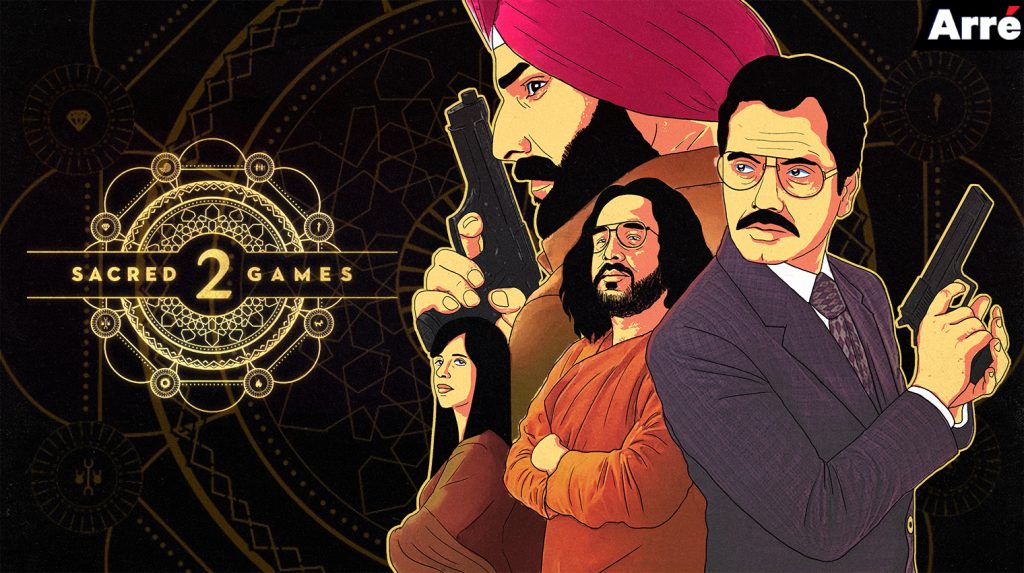
n the first episode of the second season of Sacred Games, Ganesh Gaitonde (Nawazuddin Siddiqui) lays down the doctrine of human evolution. “Asli dharam insaan ko batata hai ki aage kya hai. Insaan se apun next kya banega, kidhar jayega. Croron saal ka yeh chutiya khel,” he says while voicing over a scene of Sartaj (Saif Ali Khan) and Majid (Aamir Bashir) uncovering a piece of evidence that marks the entry of militant Islamism in Mumbai. Though they are three decades apart, the lives of both Gaitonde and Sartaj remain inescapably enmeshed in the rafters of faith and religion. Rather grimly, neither can estimate the enormity of the shadow it casts on reality. In Season 2, Sacred Games belatedly begins to articulate its core ideas and conflicts. But by that time it does, a kind of fatigue from Gaitonde’s endless blabbering and Sartaj’s clueless mug has resolutely set in. The result is a season that flounders and sinks through a hole in the ice, before it can walk to the glacial revelations it has been building towards for two seasons.
The second season of Sacred Games begins exactly where the first ended: Gaitonde, rescued from prison, finds himself in international waters in the hold of his mystic saviour, the godman Guruji (Pankaj Tripathi). Sartaj, on shore and a couple of decades in the future, is slowly coming closer to decoding the gangster’s last warning – an imminent attack on Mumbai that has now taken religious and nuclear dimensions. Like the first season, Sacred Games jumps back and forth in time throughout its second season, trying to tie Gaitonde’s mobster story to Sartaj’s race against time to save the city of Mumbai. Thankfully, the new season picks up the pace, especially with Sartaj’s arc that has now become a ticking thriller. Yet, both timelines, though poignant, feel dissimilar, not just because they are helmed by two directors (Neeraj Ghaywan and Anurag Kashyap; Vikramaditya Motwane is credited as an Executive Producer) but because they are written with a different tenor. Sartaj’s world remains humourless, perched on melancholia, while Gaitonde’s is more self-aware and chic.
More often than not, the show burdens its narrative by tying itself in knots and subsequently trips over its convoluted digressions and subplots. Netflix
There are then some genuinely baffling inconsistencies in the writing. In an episode when a junior officer tells Sartaj that a colony became a Muslim ghetto after the 1993 Bombay riots he asks, rather naively, “Idhar kyun?”. “Kyunki aur kidhar jagah nahi chori”, Majid disquietingly interjects. Four episodes later, Sartaaj schools an Islamophobe in the history of Islam. Sartaj’s ex-wife Megha randomly pops in and out of the show’s world. Gaitonde’s biggest enemy, Isa (Saurabh Sachdeva) remains an ever-present yet undefined accessory. Most detours of Gaitonde’s life seem excessively fleshed, done for the sake of the spectacle, not the story, leading to a dull initial few episodes. Even though the second season of Sacred Games is unquestionably better than the first but it drags and postures more than it probably needed to. It has a visible Gaitonde problem, a gospel it has built and now can’t shake; a hole the show pre-emptively dug to deposit its intellect and which now feels like a grave. In fact, the second season becomes sharper, only midway, when it sheds the deadweight of Gaitonde’s imprecise journey. More often than not, the show burdens its narrative by tying itself in knots and subsequently trips over its convoluted digressions and subplots. It gets its act together as a last-ditch necessity rather than design, and ends with teasing another season. I couldn’t help but wonder if too much time has already passed waiting for this show to become imperious rather than merely sophisticated. “Bal nahi balidan dena hoga” (You will have to offer a sacrifice and not strength”) Guruji tells Gaitonde at one point. If only the show could internalise the dictum, and sacrifice the prosthetic indulgences to become sleek, clean and deservedly redeemable.Even though the second season of Sacred Games is unquestionably better than the first but it drags and postures more than it probably needed to.