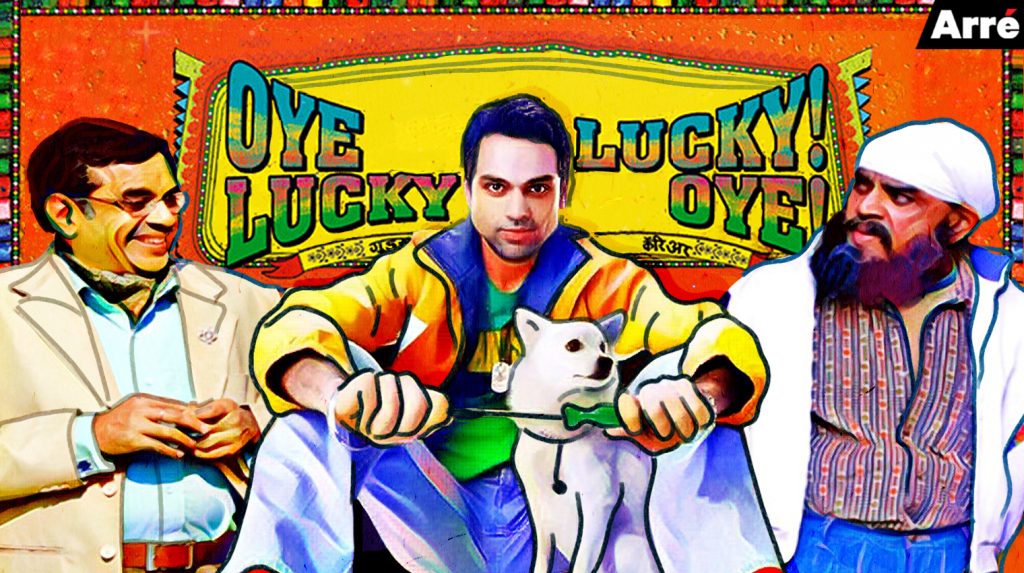

In the opening scene of Dibakar Banerjee’s
Oye Lucky! Lucky Oye!, an elaborate press conference – well, by Delhi Police standards – is underway. At the conference, we see “superchor” Lucky’s exploits through the years: A stream of stolen riches that include TV sets, music systems, family portraits, dust-laden figurines, alarm clocks, and even a dog. In a spot of unintended, but completely believable real-life comedy, a couple of women fight over a jewellery set and the hapless cops turn to Lucky to clear the air. Lucky, after all, is a celebrity thief. The film opens and ends with an episode of Criminal, a fictional crime reality show that profiles the life of criminals like Lucky. But Lucky’s world is less fiction and more reality – as real as the crowded bylanes of Patel Nagar. Lucky lives neither in the tony South Delhi of Aisha, nor in the aesthetic grime of Masakalli’s historic Dilli 6. He’s from a Dilli, which defines the experience of many middle Dilliwalas, where crime and punishment blend as easily as saunth and curd in a dahi bhalla. Oye Lucky! Lucky Oye! might have appeared a decade ago, but is just as relevant now. We live in an era when multiple governments are conning us into playing “statue-statue” and papering over our built heritage. Our natural heritage, in the meanwhile, is being taken care of by venture capitalists, who seamlessly pile on unpayable debts that go into so many zeroes that Aryabhatta would get anxiety attacks. In times like these, what’s a thief who steals everything from luxury sedans to pets? To that end, in an interview from 2008 before the film released, Banerjee clarified that Oye Lucky! Lucky Oye! wasn’t an outright comedy: That it was darker and spoke about the pressures of inequality and ambition that find their roots in a typical lower-middle-class upbringing. In other words, Lucky is subject to the same psychoses that afflict the rest of us.The opening up of the economy in the ’90s brought about a generation that sought immediate gratification – that applies to a small-time thief too, who holds the simple aspiration of being rich and respected (two words that he believes belong together).We meet Lakhvinder “Lucky” Singh, aged 14, when the seeds of upward social mobility are slowly sprouting in his mind. In one scene, Lucky and his friends stare gobsmacked at the sight of children their age roaming around in a Mercedes, fully loaded with “shoo-shaa” power windows and the power that is endowed by the company of the opposite sex. This is when desire seeps as the poignant “Tu Raja Ki Rajdulari” plays and everything in life slows down to half speed. This is not an isolated scene: The thematic device of slowness is used every time Lucky is met with an unquenchable longing for something his upbringing has denied him, be it walking into a discotheque with a “sofe ke kapde wala” suit or having a girl ride pillion on a bike through his gully. This was once all of us. The opening up of the economy in the ’90s brought about a generation that sought immediate gratification – that applies to a small-time thief too, who holds the simple aspiration of being rich and respected (two words that he believes belong together). If Oye Lucky! Lucky Oye! is a dive into the psychological depths of a thief, the answer at the bottom is the same: That at some level, driven by the same motivations and triggered by the same mishaps, we are all dysfunctional. Even a celebrity superchor like Lucky, the starring hero of his own story where he very rarely plays the villain. The characters that dent and shape Lucky’s stippled psyche, are the multiple “father figures” that Paresh Rawal plays brilliantly. His Punjabi dialect might be off, but he pervades Lucky’s entire life. Lucky’s three fathers provide him with some aspiration – and later desert those very aspirations – leaving him more muddled every time. Lucky’s estranged father who brings home an “aunty”, and is the root cause of dysfunctionality in the household. The stability that eludes him at home, results in a search of a father figure who can offer him some measure of respectability, even if it comes by way of ill-gotten wealth. The most influential figure out of the three is Gogi Bhai, a small-time dealer of stolen goods, masquerading as a “party wale” singer. Gogi Bhai is #TheGoodQuote of crooks, constantly spewing one-liners like “Sayaana kutta na beta… goo khaata hai.” When Lucky finds himself reduced to playing second fiddle in Gogi’s scheme of things, he decides to go it alone.

Even a celebrity superchor like Lucky, the starring hero of his own story where he very rarely plays the villain.
UTV Motion Pictures