
W
hen Kalu wasn’t gallivanting around town, he had only one job. He would lie sprawled outside Regal Cinema, contending for moviegoers’ attention, jonesing for tourists’ affection. An alpha male pariah dog with a penchant for travelling, Kalu was a handsome pooch blessed with a lustrous coat of black olive fur and a strapping physique. If Kalu could speak, he’d point to the funny scar on his face and probably say, “Kalu main hoon, mark idhar hai.”
“I’m not ill,” a little tag on his neck read, “I am being treated by Welfare of Stray Dogs (WSD).” Nothing was the matter with Kalu except for some weird bout of feverish twitching that would instantly worry concerned passersby for his life. The neurological issue would be cured by WSD’s care, but not before Kalu had exploited his condition to cosy up to kind strangers – to joyously sip bowls of chilled milk sourced from the nearby Barista, or even rock a funky tee that a generous foreign tourist once relieved himself of to drape Kalu with.
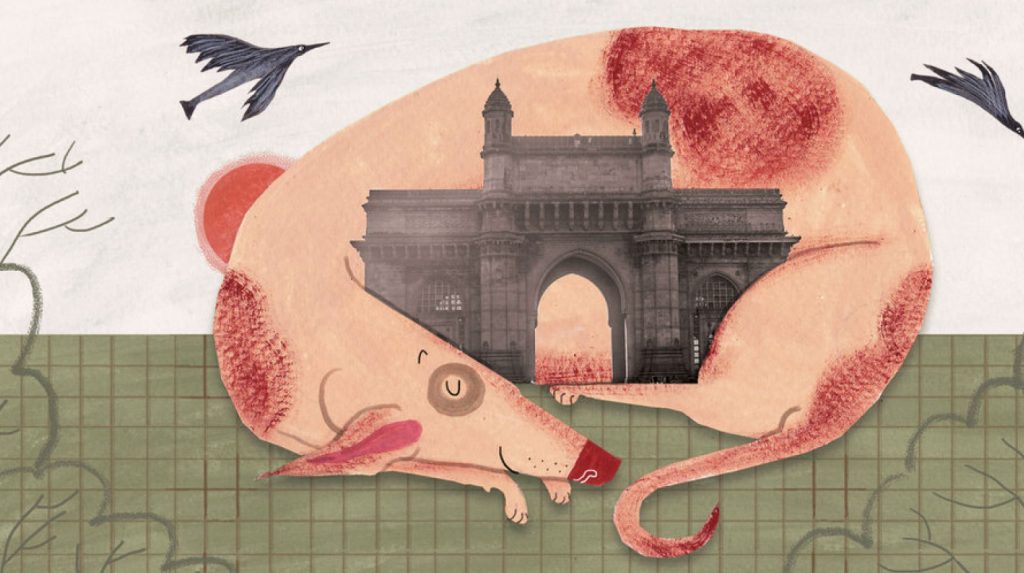
“Kalu knew how to charm people. He was a terrific actor,” says Abodh Aras, the most affable CEO of WSD and an unmatched authority on stories and eccentricities of strays in Mumbai. Aras has recently collaborated on a picture book for young readers, My City, My Dogs, along with photographer Hashim Badani and artist Sumedha Sah. The illustrated volume, published by Pratham Books, profiles nine of Mumbai’s many lovable street dogs, of which Kalu is one.
If dogs were on Instagram, Kalu would have been that annoying dude who posts pretentious selfies captioned #wanderlust and #TakeMeBack. So customary were the itinerant Kalu’s commutes that his routine disappearances wouldn’t bother his human acquaintances.
But one day, about four years ago, Kalu didn’t return to Regal for a week.
© Pratham Books / Sumedha Sah
In fact, the incredible navigational compass of Mumbai’s strays would put many Google Maps-thumbing, directionally challenged humans to shame. Right after being treated at WSD’s kennel in Mahalaxmi, an old dog jumped out of the taxi’s rolled down window and vanished into the night. “The following day, that dog was spotted right back where she belonged, near Worli’s Campa Cola Compound,” Aras recalls. Another dog at Nariman Point would apparently run 18 km with a runner during his practice, only to meet him the following day again at Nariman Point. While the streets are filled with Kalus and Aishwaryas and Deepikas and Shahrukhs, stray nomenclature throws open a treasure chest of anecdotes. “Abhi Aaya” was named thus because whenever his street-vendor caretaker would look for him, he’d always be there. Tamatar, a grey stray near Mahalaxmi’s Shobha Restaurant, loves chomping on a ripe tomato in one go. A Chembur dog, Shengu, kicks back with the shingdanawala (peanut vendor) and snoozes under his thela. My favourite though, is Periappa, who has a fondness for idlis and dosas served at Matunga’s South Indian joints. Once, looking for a stray named Whisky, Aras landed at the Colaba dive, Gokul. “Whiskey kahaan hai?” The waiter at the door replied with a straight face, “Whiskey andar hai, lekin hum baahar nahi laa saktey. Aap ko andar aana padega.” It then dawned on Aras that he was talking about the drink, not the dog.“In a boxed-in Mumbai slum, the parents, children, four dogs and even more cats co-exist – and coexist well.”

© Pratham Books / Sumedha Sah