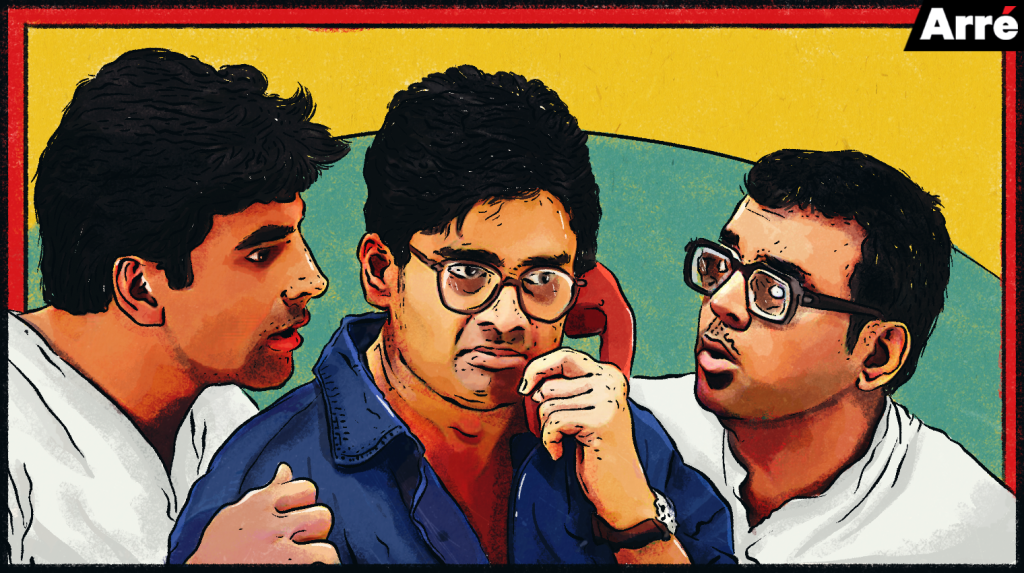

If you haven’t seen Hera Pheri yet, the film’s logline is pretty straightforward: Three down-on-their-luck, yet good-natured bachelors try to make quick money by inserting themselves into a seedy kidnapping scheme. However, most people only recall Hera Pheri as a bunch of guffaw-worthy skits; the narrative is secondary. The first half is a number of hysterical sequences of Raju and Shyam trying to one-up each other at the expense of Baburao’s property and personal health. And in the second half the three of them screw up kidnapping 101, one hilarious gag at a time. It really doesn’t require you to pay attention to the plot because its one-liners are what keep you rolling in your seats. Maybe that’s why the film has aged perfectly for the meme generation with our ten-second attention span and voracious appetites for instant punch-lines. Countless sequences and dialogues from Hera Pheri have gone on to become part of contemporary lexicon and often serve as ice-breakers at parties. There are innumerable scenes from the 20-year old film that are still being used as popular meme formats. In fact, both Hera Pheri and its sequel Phir Hera Pheri are perhaps two of the most memed films of all time. Whether it’s “Aurat ka chakkar”, “Zor zor se bol ke sab ko scheme bataa de” or “Yeh baburao ka style hai”, most quote-worthy dialogues from Hera Pheri have been weaponised by memelords into sound commentary on current happenings.At a time when the world cherishes laughter the most, it is films like Hera Pheri that serve their purpose: providing much-needed relief from reality.

 While there will be naysayers, I believe the sequel wasn’t nearly as impactful as the first film. Hera Pheri was the kind of film that the neighborhood kids reminded each other about, if it came on cable TV. Its impact on young millennials growing up in the 2000s was immense. In school, we’d compete over who could do the best Baburao Apte impression. We legit rehearsed our “woh toh main mast tel mein fry kar ke kha gaya” to get it to sound as close to the original as possible. I have friends who still call helmet, “hamlet” and a colleague claims to have duped countless society watchmen by filling “Kabeera” followed by “28881212” or “teen takley one two one two” in their visitor guest books.
Though I highly doubt the legitimacy of that last one, there’s no denying that Hera Pheri has etched its place in modern-day, middle-class India’s hearts. And right now, at a time when the world cherishes laughter the most, it is films like Hera Pheri that serve their purpose: providing much-needed relief from reality.
While there will be naysayers, I believe the sequel wasn’t nearly as impactful as the first film. Hera Pheri was the kind of film that the neighborhood kids reminded each other about, if it came on cable TV. Its impact on young millennials growing up in the 2000s was immense. In school, we’d compete over who could do the best Baburao Apte impression. We legit rehearsed our “woh toh main mast tel mein fry kar ke kha gaya” to get it to sound as close to the original as possible. I have friends who still call helmet, “hamlet” and a colleague claims to have duped countless society watchmen by filling “Kabeera” followed by “28881212” or “teen takley one two one two” in their visitor guest books.
Though I highly doubt the legitimacy of that last one, there’s no denying that Hera Pheri has etched its place in modern-day, middle-class India’s hearts. And right now, at a time when the world cherishes laughter the most, it is films like Hera Pheri that serve their purpose: providing much-needed relief from reality.
Like a lot of my fellow countrymen in lockdown, my mum has spent a majority of the past few days yearning for light-hearted distractions from the horrors COVID-19 is inflicting on the world. In a bid to relive her childhood memories, attached to a youthful Dharmendra and his quirky portrayal of Dr Parimal Tripathi, she’s been spending her afternoons re-watching Chupke Chupke (1975). It makes the moroseness of the news easier to deal with, she claims. And I imagine a lot of millennial Indians are probably rewatching Hera Pheri for the same reason. In today’s day and age, Hera Pheri’s second half wouldn’t exist only because Truecaller would immediately tell you the difference between Star Garage and Star Fisheries. But each generation needs a Baburao Ganpatrao Apte or a Dr Parimal Tripathi to make dissociating from death and despair a little easier. Because even though sanitisers can help kill the germs on your hands, it’s nostalgia that helps cleanse the mind.That’s the power of a good Bollywood comedy right there – it lightens and uplifts moods.