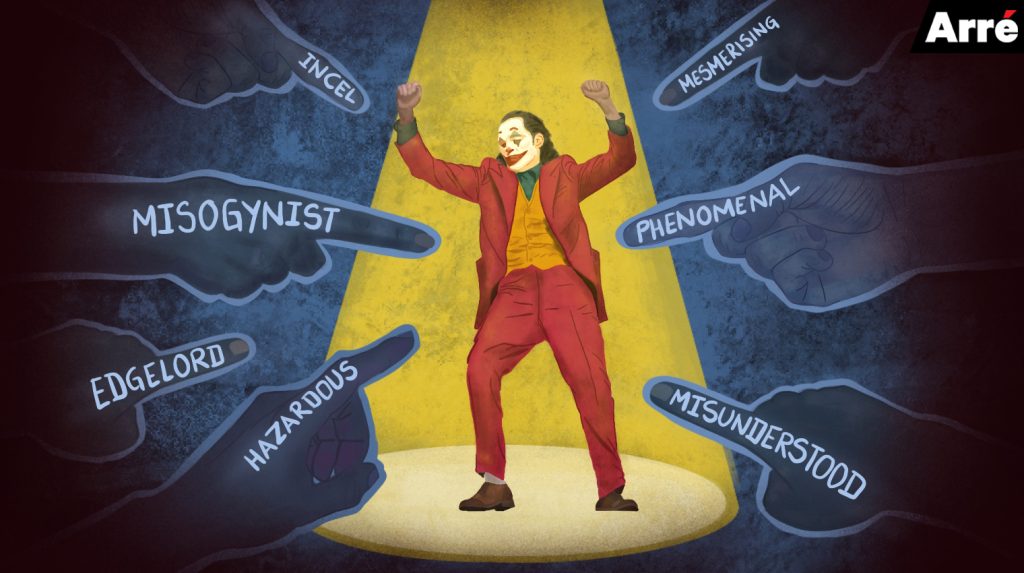

“I
rresponsible”. “Mesmerising”. “Cinematic masterpiece”. “Grim”. “Shallow”. “Hauntingly beautiful”. “Operatic”. These are some of the epithets bandied about Todd Phillips’
Joker. The polarising reactions are proof that the film has touched a nerve. Even though my mind wasn’t blown by the film, I did find myself on the other side of the fence that promptly labelled it an incel manual. I saw Joker as a cautionary tale of an incel – an alienated, impoverished, mentally ill, self-pitying, part-time rent-a-clown who nurtures aspirations of being a standup comic and is unable to come to terms with his lack of talent. It struck me as a character study of a man-child with a persecution complex that fuelled his vengeful rage. Joker is set against the backdrop of a seedy Gotham city replete with a garbage strike and disproportionate distribution of wealth. Arthur Fleck (the inimitable Joaquin Phoenix) is in state-sponsored therapy and on seven different kinds of medication. What happens when his counselling and source of medication are suddenly withdrawn by the city and his colleague, Randall offers him a weapon? “I’m not supposed to have a gun,” is Fleck’s primary response. He is not the one to seek out the pistol. Here, Randall serves as a stand-in for the system that lends him the firearm, defunds mental health, and shapes the metamorphosis of Fleck from a victim to a perpetrator. Even then, the film never denies that Arthur Fleck turns into a psychopathic, nihilistic murderer. What most angry criticism of Joker tends to have missed is that getting inside the headspace of a culprit is not tantamount to validating it. Likewise, acknowledgement of mental health does not translate into negation of accountability.But perhaps why I found myself drawn to the ideas in Joker was because they challenged my obstinately held principles and posed moral dilemmas. YouTube
But perhaps why I found myself drawn to the ideas in Joker was because they challenged my obstinately held principles and posed moral dilemmas. For me, Fleck didn’t evoke sympathy as much as inquiry, underlined by a need to understand the sociology of his pathology. In an op-ed in The Guardian, writer Micah Uetricht dissects the film’s message, “Arthur has more than his share of problems, but a few of them would have been solved, or at least adequately and humanely managed, in a society whose budgets were oriented more towards people like him than Wayne. But he does not live in that society, and neither do we. Instead of public services and dignity, he gets that most American of consolation prizes: a gun, and the sense of respect that, while ultimately hollow, has long eluded him.” Similar to Joker, Jordan Peele’s Us also hypothesised the takeover by the disenfranchised recently. The anarchy in both the films pulsates with a similar intensity. Joker is an acutely observed depiction of how the invisible and embittered are failed by the system that fosters gun culture. The most I can accuse Joker is of not having the answers to the questions it highlights and it revels in the conundrum it poses. But on a whole, Joker incites empathy, not emulation.Joker struck me as a character study of a man-child with a persecution complex that fuelled his vengeful rage.