
T
he first time I watched Jaane Bhi Do Yaaro, I was a 10. As is expected from a 10-year-old, my absolute favourite scenes in the movie were the most bizarre and the funniest, like the one where Pankaj Kapur and Satish Kaushik insist on looking under Om Puri’s “wig” to find “hidden” photographs. And because I was a morbid soul even as a child, the misadventures of the dead body that are the highlight of the movie continued to be etched on my mind for a long time.
As a kid, I obviously fixated on the funny and ignored the dark undertones. As an adult, weighed down by the knowledge of all the wrongs the movie is trying to address, every laugh it evokes is laden with some kind of a trauma, a sense of an abject helplessness that defines the landscape of Jaane Bhi Do Yaaro. And that is the real brilliance of the film as an honest entertainer that cuts across ages. It refuses to be weighed down by its larger themes without compromising on them.
Jaane Bhi Do Yaaro is cynical, dark and distressing. It is also insanely funny. It is almost as if an Ayn Rand story met David Dhawan, which is about as disturbing a dichotomy as it is effective. And in this particular case, hilarious.
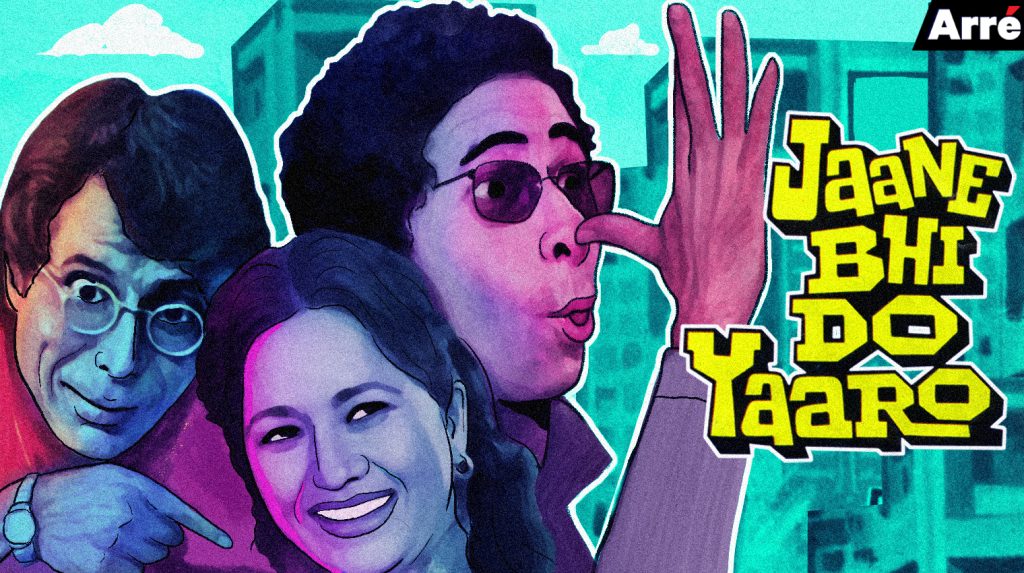
Made on a shoe-string budget of ₹5 lakh by Kundan Shah, with a bunch of then mostly unknown actors and team, Jaane Bhi Do Yaaro is a rare artistic feat that transcends every pragmatic consideration and common sense. It is art at its purest, and the most subversive best. It is also art that reset the boundaries of how Indian cinema understood and defined absurdism, and the humour that came with it.
Whether it is the legendary, pop-culture favourite Mahabharata scene, or the missing body trope executed brilliantly, Jaane Bhi’s set pieces are a lesson in comedy that does not rely on vulgarity, insult or any other cheap shortcut to induce laughter. National Film Development Corporation of India
But it is not just its politics that forms the high point of this story. It is the gags. For all its political and intellectual leanings, Jaane Bhi Do Yaaro is a slapstick that never goes easy on absurdist humour. Whether it is the legendary, pop-culture favourite Mahabharata scene, or the missing body trope executed brilliantly, Jaane Bhi’s set pieces are a lesson in comedy that does not rely on vulgarity, insult or any other cheap shortcut to induce laughter. Unlike modern cinema, it is a movie that almost wholly relies on its story to pull its weight. The writing on paper is exceptional, bolstered by the brilliance of its motley actors – Naseeruddin Shah, Ravi Vaswani, Pankaj Kapur, Satish Shah, Om Puri, Satish Kaushik – who commit to the nonsense with the same enthusiasm that they reserve for the serious themes. Rewatching Jaane Bhi Do Yaaro is a lot like watching serendipity in motion, a celluloid history in making. It is a proof of the fact that great stories and great actors do not thrive because of expensive productions. They do so despite them. There is a reason why the movie’s excellence remains unparalleled. It was easy to copy the form. It was the substance, the soul of that story that is irreplaceable. Nobody wrote a script like that again. Nobody dared. Not just because it was politically sensitive. But perhaps because it was impossible. The movie was and continues to be a pop-culture force. “Shaant gadhadhari Bheem, Shaant”, is not just a throwaway dialogue. It is a reference that cuts across generations of people, making fun of pointless outbursts, many of them not even aware of the source. Not consciously anyway. Jaane Bhi Do Yaaro is a running joke that has outlasted decades. Perhaps because in its utterly helpless cynicism, it affords a rare catharsis to the common man who continues to be as beleaguered by corruption and systemic greed as he was 36 years ago. There is something deeply depressing and morbidly funny about the continued relevance of the film in our world. Which perhaps is the most accurate summary of everything it stands for. Because if there is one thing that Jaane Bhi Do Yaaro teaches us, the one timeless lesson, it is that the joke is never on the system. It is always on us, the common man.The movie was and continues to be a pop-culture force. “Shaant gadhadhari Bheem, Shaant”, is not just a throwaway dialogue.