
T
here’s a scene in Raazi where, on the last day of 20-year-old Sehmat’s (a vulnerable Alia Bhatt) month-long training at the RAW headquarters in Delhi, her handler, Khalid Mir (Jaideep Ahlawat) asks her a pertinent question. “Why did you agree to this?” he asks, still unable to wrap his head around the fact that a college girl is ready to have her life and dreams uprooted at the cusp of her youth. His query isn’t unwarranted; before her induction into the world of Morse codes and revolvers, Sehmat led a seemingly undisturbed life far removed from it, studying at Delhi University. Her father Hidayat Khan’s (Rajit Kapur) ill-fated, terminal lung tumour diagnosis, sets in motion a chain of events that forces a meek yet resourceful Kashmiri girl to mould herself into a masterful Indian spy. As his dying wish, Sehmat’s double agent father wants his daughter to carry forward his legacy of subterfuge in Pakistan. Hidayat Khan would pass information about the plans of the Indian military to Pakistani brigadier Parvez Syed (Shishir Sharma) periodically, in the hope of being in the know if Pakistan decides to attack India. But since it’s 1971 and the two countries are on the brink of war, Sehmat’s role in the proceedings requires a whole lot of sacrifice, determination, and an appetite for brutality. For, Khan decided to marry Sehmat off to Syed’s younger son Iqbal (Vicky Kaushal) so that she could infiltrate an enemy house as the “eyes and ears” of her nation. Answering Mir’s question, Sehmat echoes her love for her “mulk” (a word repeated generously in the film) and tells him that there’s no way other than prioritising it over her future. “Main mulk hoon. Main hindustan hoon,” she says; an indication of how intertwined her identity is with that of her country. In any other film, this would have been the pinnacle of a selfless nationalistic moment that would have elicited raucous seetis and taalis. But Raazi isn’t that film, for this moment is nothing but a ruse. Her “real” answer comes a little later, when she lets slip that for her, patriotism is an inheritance, almost like a family business that she’s duty-bound to carry out.
For a film that has clouds of nationalism overpowering every frame, the implication that patriotism is a choice – one that the protagonists are not even offered – is a brave one to make. Yet it seamlessly fits in. For Meghna Gulzar has ensured Raazi isn’t a patriotic film. Instead, it’s a film about the aftermath of patriotism. At its heart, it’s a doomed ephemeral love story between a Kashmiri spy and a Pakistani army official. It’s also a seething account of the countless women who are left behind as the indirect casualties of enmity. But, most importantly, the film is a story of heartfelt loss; of a family, of a wife, and, of a spy’s faith in her “mulk”. In effect, Raazi holds up a defiant mirror to the very foundation of patriotism, goading introspection on how we’ve unquestioningly agreed to the pound of flesh it demands, without any bargain. The film brings this out by how empathetically it paints its leads; neither is any Indian a chest-beating, handpump-uprooting hero, nor any Pakistani a beard-stroking outright villain. Instead of being glorified, the strains of nationalism are shared. There is no better evidence of this than in “Ae Watan” which manages to democratise patriotism, becoming a song that can apply to people on both sides of the borders (It helps that the song is beautifully picturised in the film, where both Sehmat and her students are shown singing it together as an ode to their respective countries). The song’s inclusiveness is further elevated by the fact that it comprises a line from a prayer written by Muhammed Iqbal, considered the “Spiritual Father of Pakistan”. Raazi then examines the duality of patriotism, with a razor-sharp focus on the human cost of the “courage” required for it. It delves deep into the ugliness of patriotism, and its ability to make monsters of us all. Take Sehmat and Iqbal for instance. In any other circumstance (or film), they’d be soulmates. Despite being pushed into togetherness, they develop the sort of connection that most people take years to find. Iqbal is thoughtful and chooses to earn his place in Sehmat’s heart instead of forcing it, while Sehmat takes to showing her concern — and by extension — affection in small ways. The first time they kiss, it happens on her own terms and their brief union is laced with a rare kind of sensitive sensuality. (It helps that there’s a woman behind the lens; also evident in how she shoots the training montage without reducing her lead to a sexy, femme-fatale version). It’s precisely why their confrontation toward the end is laced with such melancholy. There’s no one who can understand their nationalistic actions better than the other and yet it’s their respective patriotic duty that sounds the death knell on their union.Meghna Gulzar’s Raazi manages to nuance the idea of patriotism, and lace it with a conscience.

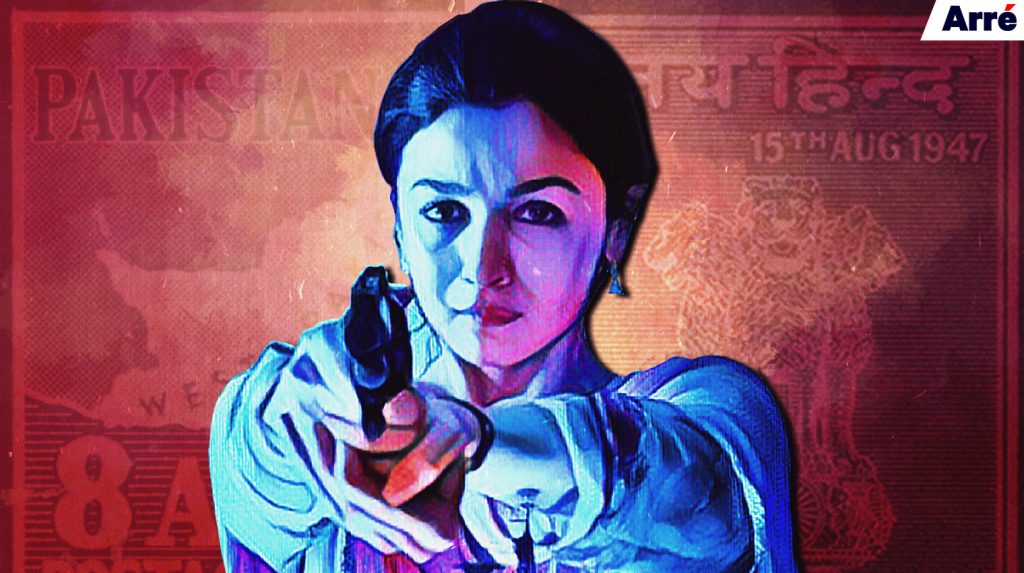
In a different circumstance or a film, Sehmat and Iqbal would have been soulmates.
Image credit: Dharma Productions