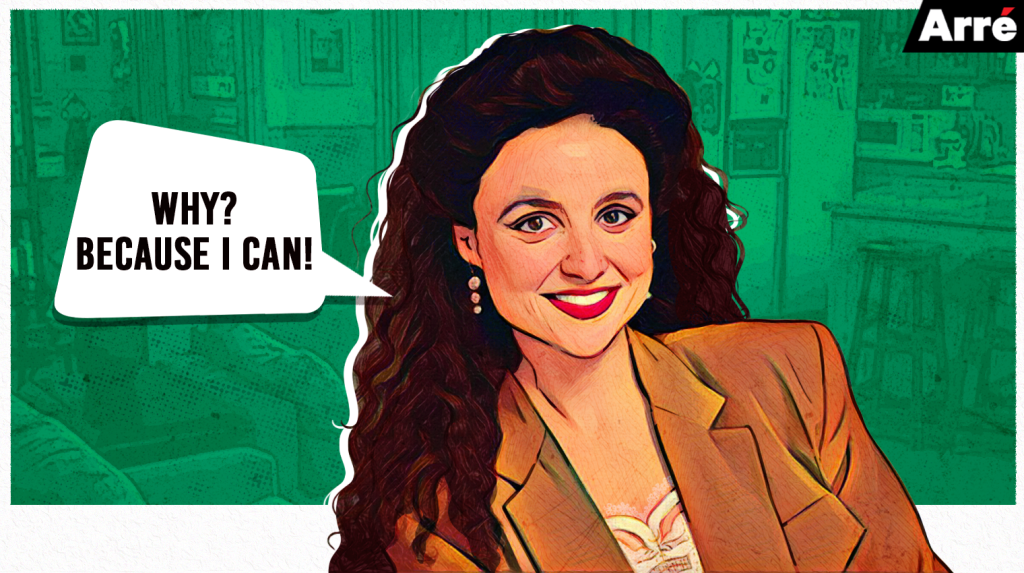
Smart, assertive, and never one to back down from a fight, Elaine Benes can just as often be paranoid, neurotic, and difficult. Castle Rock Entertainment
Posted inPop Culture
Rediscovering the Charm of Elaine Benes, TV’s Favourite Feminist
As we plunged deeper and deeper into lockdown this year, all of us took to seeking out familiar, comfortable things that brought us joy. For me, this meant binge-watching sitcoms that I’ve already watched many times over. Seinfeld was my first choice; of the stellar cast, Julia Louis-Dreyfus has remained a constant favourite. In creating Elaine Benes, the writers and the actor hit that wonderful magic spot in making her femaleness both incidental and critical to the setup – it impacts her life, but it isn’t the source of everything that happens to her.
Sitcoms have long used what I’d call the “Robin/Lily binary” for female characters – they’re either nurturing, quirky, non-threatening women, or rebellious, outspoken women who aspire to maleness in the most superficial way. And all too often, women, in reel life and real life, either come to be defined by the roles they play in the lives of others or become vehicles for a message. In the ’90s, shows like F.R.I.E.N.D.S and Sex and the City had no realistic concept of a woman without a man, even as they spoke to female audiences. Later sitcoms, including those centred around a female lead, such as 30 Rock and Parks and Recreation, felt it necessary to give their leads a relationship arc: the meet-cute, the oddball pairing, the challenges of a relationship, the final season’s picture-perfect happily-ever-after. Even today, it may be too radical to suggest a mainstream sitcom with a female lead and no relationship angle.
Elaine, on the other hand, lives an independent, self-sufficient life, one in which she has all the career and personal issues that someone in their 30s might. There’s no explicit discussion of feminism, because it isn’t required – this is already a feminist life. Smart, assertive, and never one to back down from a fight, she can just as often be paranoid, neurotic, and difficult (as a doctor notes on her chart, which she then spends an entire episode trying to erase). She works in publishing, then becomes a personal assistant, then finds her way back to publishing (even if it is J Peterman’s catalogue), becomes CEO for a hot minute and gets demoted right back. Some of her best moments come when she is made the CEO of J Peterman and she calls Jerry, cigar in mouth, feet on desk, to gloat. As he tries to cut her off and talk about himself, she interrupts him right back with a “Hey, hey! Me, talkin’…?” a line that more women need to use in workplaces, homes, and restaurants even today. Whether she’s discussing business plans with her ex-boss (“Pop the top, toss the stump!”), single-handedly driving the Soup Nazi out of business (“NEXT!”) or vengefully hoarding toilet paper to deprive a woman in the next stall, this is a character that is afraid of nothing and obsessed with everything.