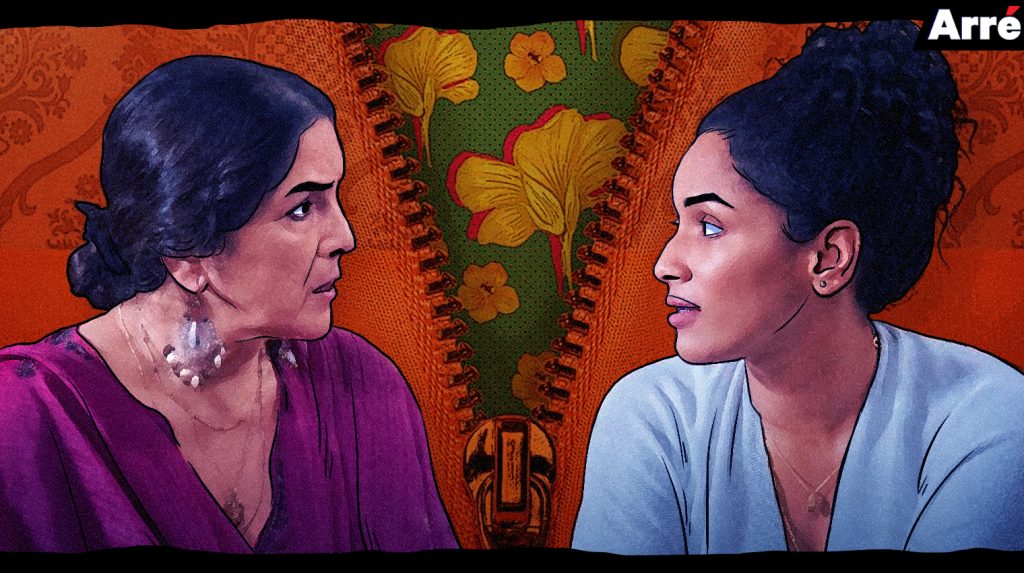

The perils of being famous If the legacy that Masaba Gupta has single-handedly managed to create for herself stems from her mother’s steadfast refusal to submit to the conventions of a society that can’t handle female independence, then Neena Gupta’s comeback to the movies is a direct result of having the backing of a daughter who reminds her to never second-guess herself only because the world can’t keep up with her. In that sense, Masaba Masaba investigates the perils of being a famous woman burdened with living up to impossible standards of public scrutiny, as well as the strenuous task of being famous in the first place. Co-written by Nair, Nandini Gupta, and Anupama Ramachandran (Punya Arora is credited for additional screenplay and dialogue), the premise of Masaba Masaba is obviously located in the National Award-winning Neena Gupta’s now-viral Instagram post about being on the lookout for work. At the time, it was dubbed bold, courageous, albeit a little naive. But seeing Masaba Masaba fictionalise the moment, born out of Neena Gupta’s dissatisfaction with being passed over for roles, it becomes clear that it was nothing but an ask of dignity; an exercise in asking to be remembered. That to me, is the primary reason that Masaba Masaba works, even when it goes a little overboard with its millennial fixations (a bisexual stoner artist subplot is as dull as they come and Masaba’s new collection is literally made hashtag-friendly: #HotMess). Ultimately, it reveals itself as a show that is dedicated to being a record of the successes of women as much as the successful women themselves. There’s also the fact that Masaba Gupta, in her debut as an actor, has incredible screen presence, livening up even the most cliched lines of dialogue and filmmaking decisions. The show opens with the breakdown of her marriage, one that is handed in such a fuss-free, empathetic manner that it almost came as a shock. It’s laudable how the writers stop themselves from diving into the details of the separation or even squarely blame it on anyone, highlighting instead the fact that sometimes it’s normal for even the most loving relationships to come to an end.The six-episode show isn’t just a blank statement: It’s charming, self-aware, and occasionally witty.
Neena Gupta is a queen It’s even clever how Masaba Masaba uses Instagram as a device for emotional communication. In scene after scene, Masaba broadcasts her feelings to the world even before she allows herself the time to process it. There’s an especially bittersweet moment that captures how easy the internet has made it for the world to be nosy about the tragedy of strangers. On a car ride back home, Masaba and her husband jointly decide to break the news of their divorce on Instagram to bypass incessant questions and nagging suggestions. Masaba reluctantly agrees and cross checks the caption by him. He has one suggestion: Could she make it seem like they’re more sad about it? But the biggest reason that the show, despite its storyline devolving into abject ridiculousness in the last two episodes, remains immensely watchable is because of Neena Gupta. Playing a possibly watered-down version of herself, the actress gives a performance that carries in it a lightness of touch as well as the incomparable high of watching someone casually make a meal out of improvisation. There’s no doubt about how effortlessly she can light up the screen with the subtlest of gestures, but Masaba Masaba truly unlocks her generousness as an actor. Some of her best scenes are the ones where she shrinks herself to allow her co-actor reach their fullest potential. Granted, it isn’t the most perfect show but when you have the distinction of having Neena Gupta star in a music video where she admonishes millennials for calling her “aunty,” you can’t be much far from it.It’s even clever how Masaba Masaba uses Instagram as a device for emotional communication.