
A lonely funeral The house that my first grandfather had passed away in, ten years ago, was packed when I’d returned home from the market with funeral supplies. I had to shave my head on the apartment staircase outside, because there was no place for me to do so in the house. By contrast, this pandemic-hit funeral is like an orderly class assembly, except the kids are shaking from waves of sadness instead of cascading in-jokes. The funeral supplies are being taken care of by a company, although I brought the gangajal and sandalwood in a red cloth bag. I am struck by the irony of the situation. That my grandfather, a builder who made spaces for the city’s richer people, has a generous but spartan living room that doesn’t have space for anyone except blood relatives. He was a man with a strong, assertive presence. I think about the old photo from my parents’ wedding, where he looks like a mature Al Pacino from Scarface. His last days were spent shuttling between a hospital and at home, under a city-wide lockdown, not allowing enough people to experience his signature strong voice, those emphasised ends to sentences when he was sure he was right. The last time he held Saturday night court to an audience of tikka eaters and whisky drinkers had been in an era without masks. This wasn’t the farewell he deserved. This isn’t the farewell any of us deserve. Someone is reading from the Bhagavad Gita, while a bhajan plays endlessly on loop. The room is mostly people in fantastic clothes, their eyes glazed over like sugar donuts. Some eyes are red, others distant, lost in Memoryland like I’ve mostly been. It remains odd to make real eye contact, hold someone’s gaze, and feel empathy for the shared circumstance we are in. Even in this small collective, the mourning and grief has been privatised, like watching Netflix alone. I cannot really tell how others are feeling by looking at their faces. There should be more people here, so we can pay tribute to this man and acknowledge each other while we do it.Death is still foreign enough that I find it does a discourtesy by not texting before calling.
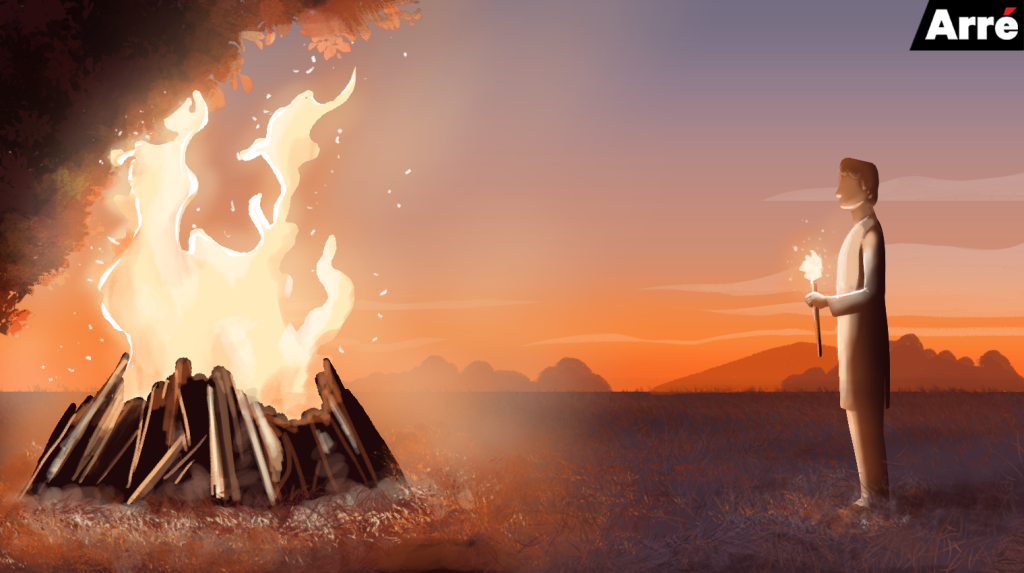
The final farewell When it is time for the antim sanskaar, we proceed toward the building lobby all masked up. Someone is using a phone camera to show my grandfather’s body to someone who could not be present for the final time. The only respite from this singular dystopian world, is the chanting. At least there is some external manifestation of the shared experience that this man’s life was, that every human’s life is. We drive through unusually nimble Mumbai traffic to a desolate, grey-ed out cremation ground. I am one of the kandhis, or people lending a shoulder to the pyre. This is the final destination, where my grandfather goes from a person to a body. The clouds are flexing, but there is no rain, except the fresh wave of tears from another person each time. Maybe there is a dignity in this rare privacy. Few but significant people have made it to this funeral, unlike my other grandpa’s cremation which swelled into a small concert. It is kinder on the eye and the soul. I wonder if tears kill covid, so I could at least see the people around me behind their masks. I want to remember their faces instead of the incomplete silhouette of their clothes and hair and reddened eyes. It would be cathartic to cry along with someone. To catch someone’s eye, to watch their lips shiver in simultaneous, shared misery. It’s only now that I have understood the full impact and meaning of the phrase, “grief is communal”. It is only in the absence of community that I feel the need for more people to validate my own sadness, to stand testament to the life my grandfather led. As this article puts it, “Though a highly personal experience, grief also requires to be felt in the company of other grief. It is almost indescribable the way grief shifts in the moment it is expressed out loud. In that brief encounter, one’s grief becomes the world’s grief. Although pain-staking and lonely, grief is an invisible thread that connects all of our hearts.” The quiet setting of his lit pyre is almost poetic, and it helps me process my own grief, as I break down completely for the first time in the day. My eyes are finally riverine, flowing after hours of being dammed by responsibilities. It is only now that I can mine my fondest memories with him. Those that are left of him anyway. I go home and see the ties he left me, which I wear too little. I remember the last time I saw him, a shadow of the Al Pacino Scarface photo, a definite dilution of his tikka-and-whiskey-serving avatar. His last days weren’t kind to him, and that’s why he probably left. As the shrewd businessman in him would say, “Market bigad gaya hai.”It is only in the absence of community that I feel the need for more people to validate my own sadness.