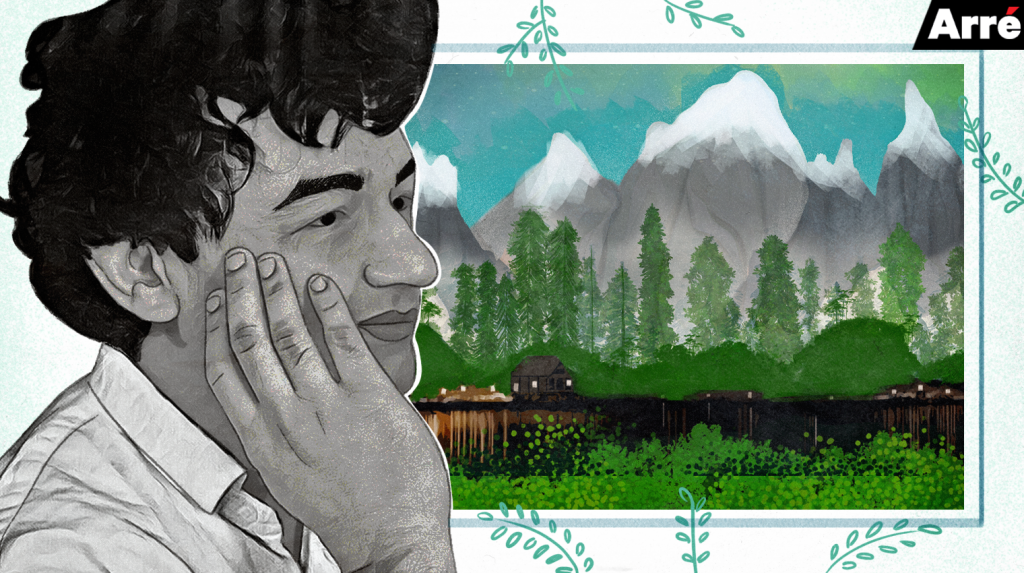

It wouldn’t be inaccurate to say that an individual’s ideals and beliefs are greatly influenced by the culture in which they are brought up – it was no different for Ali. Brought up in a secular household, his poems explore themes of motherland and how strife sullies the idea of it. The summer of 1989 for instance, was different for Kashmir as it was for him. After the allegedly rigged elections of the previous year choked dissent and paved the way for armed resistance in the valley, Ali’s poetry acquired even greater meaning. He was the lone voice that became the wounded cry of his people, capturing the brutal atmosphere of violence, arson, and political storm. His observations were impassioned and ironic, instructive as well as perceptive. In his poem, “Paradise On Earth Becomes Hell,” he wrote about the helplessness of the situation while invoking Begum Akhtar: It was ’89, the stones were not far, signs of change everywhere (Kashmir would soon be in literal flames)… I shelve “Memory” to hear Begum Akhtar enclose — in Raga Jogia — the wound-cry of the gazelle: “Not all, no, only a few returns as the rose or the tulip.” That ghazal held under her spell. But when you welcomed me in later summers to Kashmir, every headline read: PARADISE ON EARTH BECOMES HELL. Oberoi further expands on Ali’s interpretation of Kashmir, “The poet’s Kashmir is a broken promise; it is the Jhelum that carries a dismembered body, Zero Bridge and Zero Taxi Stand, the songs of Habba Khatun, Gupkar Road and Residency Road, the Times of Rain. The poet’s Kashmir is a geopolitical vision, revisited in memory, its horrors an image of graphic beauty.” You see, even as landscapes of America and India, New Delhi and Brazil, Uruguay and Chechnya jostle for space in his poetry, his words are always grounded in Kashmir. A deep sense of loss echoes through the litany of references about his homeland in his poetry. Consider this excerpt from The Blesséd Word: A Prologue for instance: Let me cry out in that void, say it as I can. I write on that void: Kashmir, Kaschmir, Cashmere, Qashmir, Cashmere, Qashmir, Cashmir, Cashmire, Kashmere, Cachemire, Cushmeer, Cachmiere, Cašmir. Or Cauchemar in a sea of stories? Or: Kacmir, Kaschemir, Kasmere, Kachmire, Kasmir. Kerseymere?In my search, I didn’t just stumble upon a poet, but also an idea of Kashmir that isn’t otherwise available.
Ali wrote about the Kashmiris who became the victims of Indian military forces, giving a peek into a world where citizens are routinely interrogated to prove their patriotism and where carrying identity cards is second nature. In “Dear Shahid,” he hauntingly captures the horrors of such oppression, “Everyone carries his address in his pocket / At least his body will reach home.” Over the years, Ali’s words are a helpful reminder of the close link that exists between language, literature and history, especially in times of crisis. While recounting the poet’s last days in his eulogy The Ghat of the Only World: Agha Shahid Ali in Brooklyn, author Amitav Ghosh, a dear friend of Ali, states that he nursed a desire to return to Kashmir. Ultimately, he was laid to rest in Northampton, in the vicinity of Amherst, a town sacred to the memory of his beloved Emily Dickinson. He died young at the age of 52 and on his grave is written: They ask me to tell them what Shahid means: Listen, listen It means “The Beloved” in Persian, “witness” in Arabic Today, it’s been six months since the abrogation of Section 370 in Kashmir that culminated in an internet shutdown. Kashmiri voices continue to be silenced today as they were back in Ali’s days. Perhaps, Ali’s writing has never been more relevant – Kashmir has never needed a witness as urgently as it does now.It wouldn’t be inaccurate to say that an individual’s ideals and beliefs are greatly influenced by the culture in which they are brought up – it was no different for Ali.