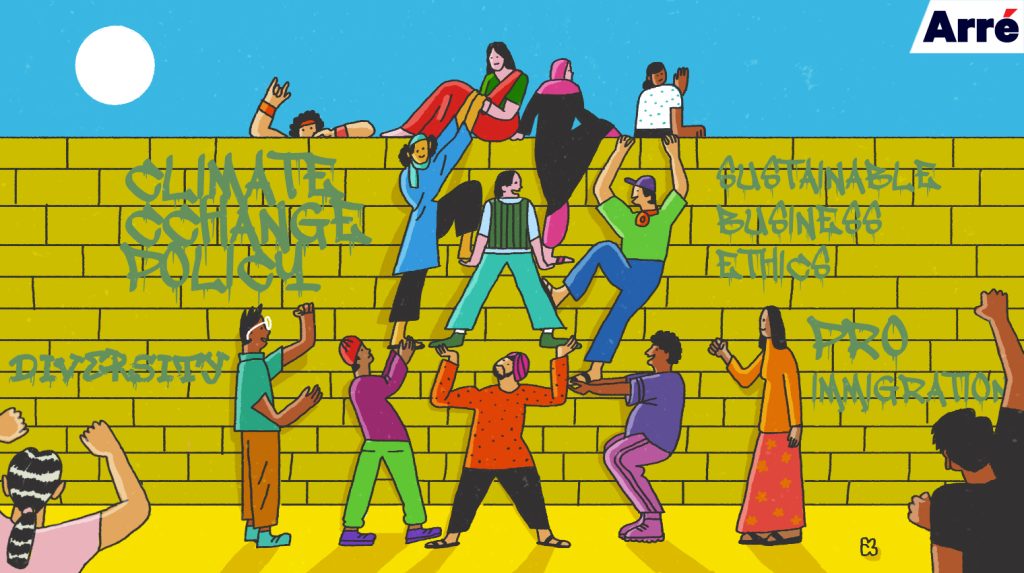

Now, I’m not saying all millennials are angels, or that all of their predecessors are evil; indeed, Facebook’s CEO, Mark Zuckerberg himself technically qualifies as a millennial, as does Saudi Arabia’s journalist-murdering crown prince. What I’m saying is, millennials are more likely to chase wealth sustainably. Whatever your political affiliation, the news and peer pressure are likely to shape a more responsible world view (as we’re already seeing, as trust in internet giants plummets). There are reports showing Business Ethics — normally considered a “timepass subject” — is in much demand in business schools. Driven by millennial demand, companies are becoming more sustainable. At the very least, even if it’s only money one is chasing, millennials are more likely to believe that investing in building trust today could lead to profits tomorrow. Technology firms do attract a more liberal mindset, and hey, if a few people have wrecked the internet today, it could be another few who fix it tomorrow. It’s also just that… It’s inevitable. I am reminded of Russell Peters’ observation that white people can try all they want to run from us, but eventually, all of the Earth is just going to be various shades of beige. That’s true for technology too. Immigration means we will see more egalitarian solutions crop up. Even Silicon Valley’s most ardent admirers will admit it’s a place largely tailored to heterosexual white males living in coastal US cities, not forseeing problems that eventually came to all tech platforms. It ain’t diversity for diversity’s sake — a woman’s opinion could have helped make Uber safer, for example. This will be bolstered by programmes such as Girls Who Code and CLT India whose alumni will be of decision-making age in the 2020s. It’s not unfathomable that they would use their brains to solve problems of underserved communities and not making an app that finds you a dog-walker (before you ask, yes, it exists, and Softbank pumped $300m into it).Millennials are more likely to chase wealth sustainably.
Millennials are also likely to infuse climate change-fighting policies and products. They’re likely to stand up for what they believe because their transgressions will be forgiven by other like-minded people, perhaps even welcomed (all people who were fired from Google for staging activism, for example, found immediate opportunities via Twitter). And the beauty of the internet is, it needs only a few people to drive it and popular opinion. While just falling short of millennial qualification, imagine what Greta Thunberg will do by 2030, when she turns 26. Imagine the hundreds of others, like her, now equipped with money, voting rights, and power. I might be optimistic here, but I do think that at least online, things are going to get better. Hopefully then, we can add online misinformation and business recklessness to things that millennials have destroyed.And the beauty of the internet is, it needs only a few people to drive it and popular opinion.