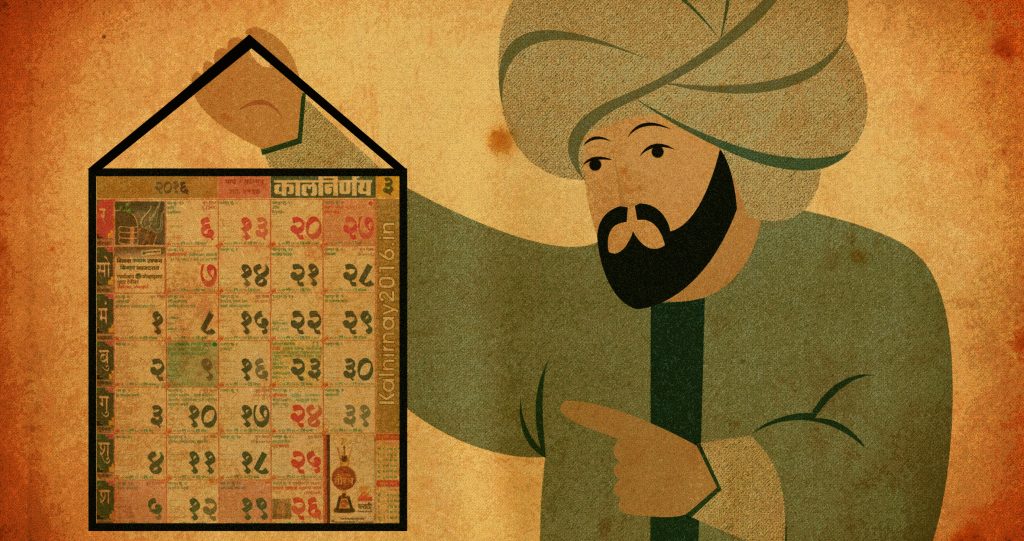

KISSsssss… The word hangs like a hiss in the tiny office. The air is heavy with incense smoke and the scent envelops all those who enter. It’s a cluttered space and peering down from the wall is an eclectic bunch – BB King, Sharad Pawar, Buddha, and Botticelli’s Venus. Jayraj Salgaonkar is sitting in the middle of it all, sipping coffee, as he spells out the mantra for Kalnirnay’s success. The world’s best-selling “calmanac”, which tells millions of Indians around the world when Ramazan ends and Govardhan Pooja begins, when to fast during Pitru Paksha, and whether onions are kosher on Dussehra, has been put together from here for 42 years now. Before Kalnirnay married the Hindu calendar with the Gregorian one, communities had their own timetables tracking the moon. So the Malayalis had the Panchangam, Maharashtrians used ghati and pal to chart rituals, and the vagaries of a lunar calendar meant that the dates of festivals varied from village to village. The confusion was made bigger by the fact that more and more Indians were as keen to observe St Valentine’s Day as Sankashti Chaturthi. So this institution introduced the Western method of keeping time to the country. “My father was an influential man with political and social clout, but even he was afraid of mixing the Western regimen with Indian religion. But the backlash never came thankfully and today we publish in eight languages,” says Jayraj, whose father Jayant, a renowned astrologer first hit upon the idea of a multi-cultural calendar in 1973.

Jayraj Salgaonkar’s father Jayant, a renowned astrologer first hit upon the idea of a multi-cultural calendar in 1973
Image credit: Abhinav Sharma
“…But religion is such a heady mix of behaviour and thought, that it will never be obsolete. ” Jayraj SalgaonkarSalgoankar considers the app a personal victory. He says he knew that he had a hit on his hands, when the pandit conducting the Ganesh puja at his family home, whipped out his phone to take cues from the app. “In the ’70s, the rationalists predicted the demise of religion by the time the 21st century dawned. But religion is such a heady mix of behaviour and thought, that it will never be obsolete. Only the ways in which we interact with it and respond to it may change,” he says. And indeed, our response to religion has made headlines over the past year. While the Islamic State’s quest to establish a Caliphate has brought religious extremism to the forefront globally, closer home rationalists have been murdered and vigilante gaurakshaks have Facebook fan pages. But Salgaonkar asserts that the continuing popularity of his brand is not a result of the Hindutva wave that’s apparent. He insists Kalnirnay is a completely secular product, pointing out that the calendar also lists important dates for Muslims, Sikhs, Parsis, and Jains. The print edition, subsidised by advertising, had Parsi industrialist Naval Tata’s TOMCO among its first sponsors, he adds. “Do you know who my most loyal customers are? It’s the butchers, many of them Muslims. Meat is not consumed on religious holidays and my calendar warns them of the days when business will be dull. And we have always got the Eid dates right. The Delhi imam may be wrong in his pronouncements, but never Kalnirnay.”