
Azadpur Mandi in North Delhi is a beehive of activity at 4 am. At the stroke of the clock, thousands of migrant labourers descend on this 76-acre sprawl to unload tonnes of produce, which starts arriving here around 2.30 am from farms across the country. Housing
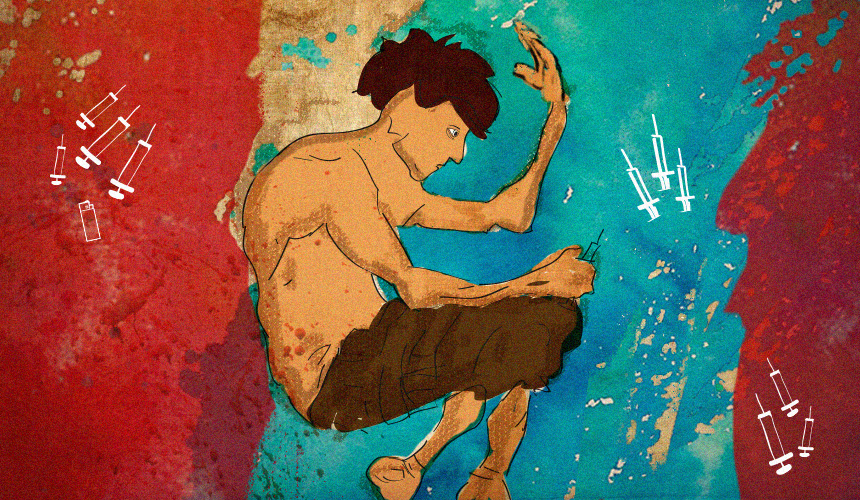
nearly 2,000 wholesalers and 2,500 commission agents, the mandi has been Asia’s biggest fruits and vegetables marketplace for nearly 40 years now. These four blocks of concrete and metal-roofed structures tend to sneakily make news for another opaque reason: A sprawling drug trade which transcends its not-so-modest boundaries. It’s a natural match, considering the market’s life of hard knocks and harder labour requires some relief, some forgetting, some taking the edge off. The walk from the mandi to nearby Mahindra Park cracks its secrets wide open. The smell of hashish – an earthy combination of sweetness and wet mud – engulfs the metro rail, bus stops, and even overcomes the stench of an open sewer nearby. A litany of small chemists line the dingy streets, including one where I see the owner lighting up a beedi while selling an elderly woman cough medicine. A panwaadi named Suman is stationed near the entry lane of K-Block, one of the most populated areas in Mahindra Park. The lane’s entrance leaves nothing to the imagination: A grubby, seemingly lonely track, dripping with the dread of worn-down kirana stores. My new friend Suman isn’t deterred though, and tells me to just walk up to the chemists and ask for a “sheeshi”, which will just cost ₹50. While we are speaking, a man north of 60, with frazzled hair and a tattered brown shirt walks up to Suman and asks him for some tobacco. He places the wrapper in his pocket and walks away to about five feet. He then pulls a plastic ziplock from his other pocket, takes out a syringe and a sheeshi, loads it from the vial and injects it into his left forearm. He closes his eyes for two minutes, then ambles to K-Block’s main lane.A Statesman report from last year found out that entire sheeshi apparatus, excluding the syringes can be procured from chemists for as little as ₹150-200.The sight is normal, the panwaadi tells me. The deeper I go into Mahindra Park, the more hashish-loving labourers are replaced by residents injecting Avil (pheniramine maleate), readily available at their friendly neighbourhood drug store. Looking down the street, I see a mass of human bodies: Slumped against the concrete wall, leaning against shop shutters, sitting around the pavement, each in their private version of heaven or hell. I first meet 16-year-old Rajat, wearing a shirt best described as formerly white, sitting on a pavement rolling smack and tobacco in a cigarette. There is Madhup close to him, lighting a pipe with a match through silver foil, smoking a cheapened and readily available variation of heroin. Any attempt at conversation with the two – or any of the other high residents of the area – is shooed away by a flick of the wrist.

Homeless addicts prepare and inject heroin under a flyover in New Delhi
Stuart Freedman / Getty Images

Drug addicts use smack in the slums of New Delhi.
Brent Stirton / Getty Images